Hardwood floors cupping after a humid Long Island summer: what it means and what actually fixes it
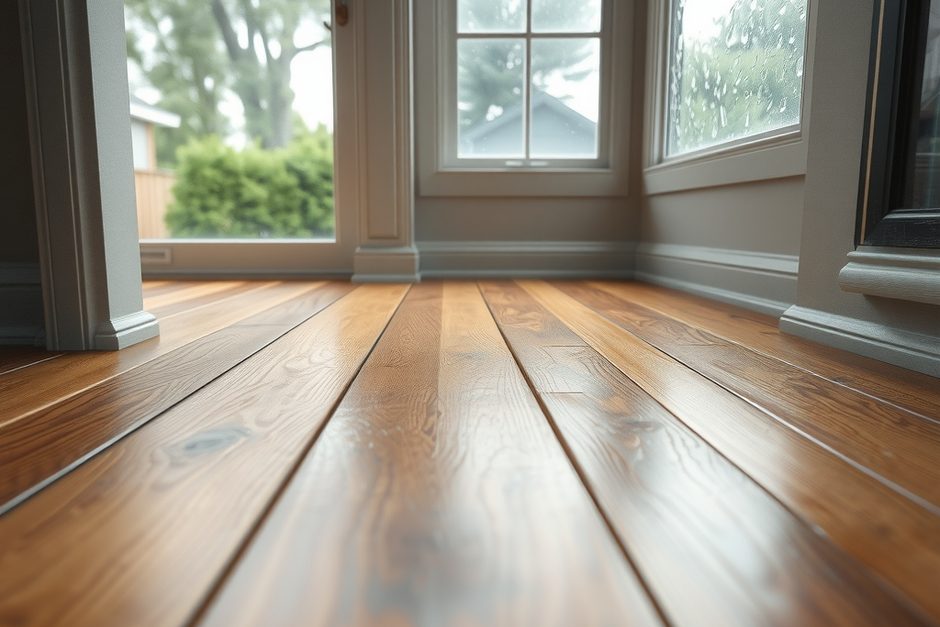
When each hardwood board feels higher along both edges than at its center, the floor is cupping. A Long Island homeowner seeing that change after a sticky summer should not rush to sand it flat. The immediate job is to find out where the extra moisture came from and give the wood time to reach a stable condition.
What cupping tells you about the wood.
Cupping happens when the underside of a hardwood board carries more moisture than its finished face. Wood changes dimension as its moisture content changes, so the edges rise and the center looks lower. The pattern may show up across an entire room after a humid stretch, or in one area where moisture is entering from below or beside the floor.
Run a straightedge across several boards and look at the direction of the curve. Edges up is cupping. A board that is high in the middle instead may be reacting to a different moisture imbalance. The distinction matters because sanding a cupped floor before it is dry can leave the boards too thin or create the opposite curve later.
Decide whether the problem is room-wide humidity or a local water path.
A room-wide pattern often follows a long humid period, while a tight patch usually points to water at that location. Start with the simplest evidence: which rooms changed, whether the cupping is worst near an exterior wall, and whether the change appeared after a spill, a wet basement, or a plumbing issue.
- Across most of one floor: Look at indoor humidity, open windows during damp weather, and moisture moving up from below.
- Near an outside wall or doorway: Check trim, the threshold, and any staining that suggests water has traveled behind the finish.
- Over a basement or crawlspace: Look below the affected area for dampness, condensation, or signs that moisture is collecting under the subfloor.
- In a narrow run by plumbing: Treat it as a possible leak until the source is ruled out.
Many post-war capes and 1950s ranches on Long Island have hardwood over a basement, and the floor can react to what is happening underneath even when the top surface looks dry. Do not assume summer humidity is the whole story simply because the change appeared in August. A localized pattern deserves a localized investigation.
Dry the cause first, then wait before deciding on repair.
Hardwood needs time to respond after the moisture source is corrected. Remove standing water, repair the leak or drainage issue, and reduce the damp condition before anyone sands the boards. Mild cupping can relax as the moisture balance returns; aggressive work too early can turn a recoverable floor into one that needs more extensive repair.
Keep the room conditions steady rather than swinging between wide-open windows and a sealed-up house. Avoid wet mopping while the floor is trying to dry. If there is a basement below, address the moisture there as well. The point is not to force the surface dry for a day, but to stop new moisture from reaching the boards.
What to document before someone evaluates the floor.
Good notes help separate a one-time summer change from an active moisture problem. Take wide photos that show where the cupping starts and close photos that show the board edges. Include anything that happened shortly before you noticed it, such as a spill, a wet basement, work at an exterior door, or a plumbing repair.
Check the same spots again after the moisture source has been addressed. If the pattern spreads, moves toward another wall, or is joined by staining or a musty odor, that is useful information. A contractor or flooring specialist can inspect the visible floor, but the history underneath it often explains why one section changed while the rest of the room stayed flat.
When sanding makes sense, and when boards need replacement.
Sanding belongs at the end of the process, after measurements and observation show the floor has stabilized. Once the cause is corrected and the boards have stopped changing, a flooring professional can judge whether the finish and wood thickness allow a refinish. Until then, the visual damage can be misleading because the floor is still moving.
Replacement becomes more likely when boards remain distorted after drying, the finish has separated badly, or water has stained and damaged the wood itself. The scope also depends on whether matching material is available, how the affected run meets adjoining rooms, and whether the subfloor needs attention. A free written quote starts with that condition check, not a guess from a photograph.
Prevent the same problem next summer.
Keeping moisture out of the building and keeping indoor conditions reasonably steady gives hardwood its best chance through a Long Island summer. Pay attention to basement dampness, wet entry rugs, window or door leaks, and any room that stays closed up and muggy. Those are small signals that can matter more than the finish on the boards.
ENERGY STAR's homeowner resources explain ways to plan home-energy improvements, while NYSERDA's homeowner page is a useful New York starting point for current resources. For the floor itself, seasonal checks of the basement, exterior entries and plumbing areas are more useful than waiting until the boards visibly change.
If your hardwood floor is cupping in a Long Island home, Just Enterprise One Corp. can inspect the affected area, identify what needs attention, and provide a free written quote within one to two business days. Call (631) 983-8079, see our wood flooring services, or read our guide to refinishing versus replacing hardwood floors.