Replacing a driveway in Islip: the apron, the curb cut and the permit most quotes leave out.
Your driveway stops being yours before it reaches the street.
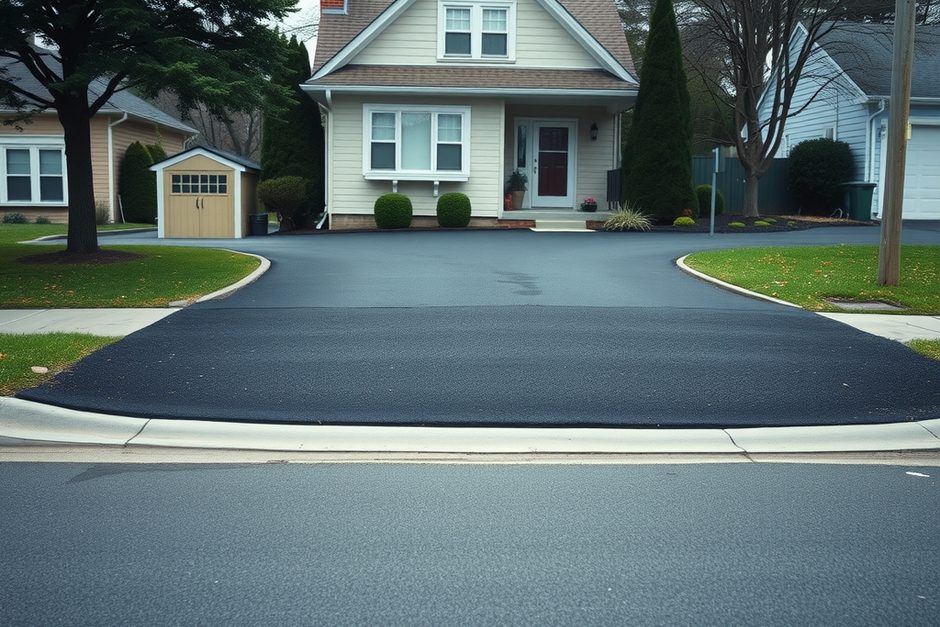
The strip of pavement between the curb and roughly your front property line belongs to the town, not to you. That strip is the apron, and it sits inside the public right-of-way. You maintain it and you park across it, but the town controls what gets built there.
Homeowners find this out at an awkward moment. Three quotes come in, two mention a town permit and one does not, with no obvious way to tell which one is cutting a corner. The apron and the curb cut always require a filing, and a quote that skips it has not priced the whole job.
The risk is a stop-work order partway through. Once the old apron is broken out and the curb is open, the house has no usable driveway, and a crew sitting idle on paperwork is an expensive way to learn a permit was needed.
The right-of-way permit is a separate filing from any building permit.
Islip handles work in the road through its Department of Public Works rather than the Building Division. The permit is called a Right-of-Way Work Permit, and it covers exactly what a driveway job touches at the street end: the apron, the curb cut, new curb, sidewalk, and any drainage going in alongside.
The Town of Islip Department of Public Works publishes the application, and the requirements printed on the back are specific. The filing has to include a survey carrying a detailed sketch of the work, and the plans go to the Town Engineer, and to Traffic Safety where that applies, showing how traffic gets maintained and protected.
There is a bond as well. Unless the project already carries a performance bond covering right-of-way improvements, one gets posted, and once the engineering division accepts the work it converts to a one year maintenance bond. The town holds security against the road settling for a year after the pour.
One line on the form matters more than the rest. The permit is not valid until the Commissioner of Public Works signs it. A verbal from a clerk is not a permit, and neither is a submitted application.
Two Islip rules quietly decide how wide your driveway can be.
Most homeowners plan the driveway first and think about rules second. Two numbers in Islip's right-of-way requirements can redraw the whole layout, and both are easy to breach on the narrow lots that fill the older hamlets. Finding out at the counter beats finding out after the forms are set.
The first is a setback. A proposed driveway has to sit at least four feet from the adjacent side property line. On a post-war cape in Islip or Bay Shore, where the house already crowds one side line and the original driveway ran right up against it, that rule alone can force the replacement to shift.
The second is a coverage limit. The driveway cannot exceed forty percent of the front yard area. This is what stops the common upgrade, where a family with two cars and a single-width driveway wants to pave most of the front. On a small lot, forty percent arrives faster than it sounds.
Walls of any type are flatly prohibited inside the public right-of-way, so the decorative piers people like to frame an entrance with have to sit back on private property.
If your street is a county road, Islip is not the one you ask.
Jurisdiction follows the road, not the house. A driveway opening onto a county road is the county's call, and the town has no say in it. Homeowners on the bigger through roads routinely file in the wrong place first, lose a week, and start again at the right agency with the same drawings.
The Suffolk County Department of Public Works owns the county road network and publishes both a county road listing and a directory of town highway contacts, which between them settle the question in a couple of minutes. State highways are a third category again.
If the driveway work is tied to something larger, a new garage or a widened front entry, a second review runs in parallel. Islip's Building Division checks those applications against the state code and the town's own zoning, and it takes filings electronically.
The town cares as much about the road as about your driveway.
Nothing in the right-of-way requirements is about how your new driveway looks. It is all about the condition the public road gets left in, because the town has to live with it. This is where cheap work shows up first, usually as a settled trough across the gutter line a year later.
The specifications are concrete. Trenches have to be saw cut and straight, with a minimum restoration width of twenty four inches for curb and driveway work. A trench running parallel to an existing curb has to leave a stretch of asphalt beside it or else extend to the curb line. The road itself gets rebuilt in layers, a recycled concrete base under a binder course under a top course.
Before any of that, the ground gets marked. Under the state rule governing underground utilities, the contractor has to call 811 for a full mark out at least two business days ahead and no more than ten. The town also wants its engineering inspector notified before work starts when the job runs alongside a building permit.
On Long Island the calendar decides more than most homeowners expect.
Driveways are a weather trade. Concrete and asphalt both care what the ground and the air are doing when they go down, and our freeze and thaw cycle is hard on anything placed badly. The working window is wider than people assume. The planning window in front of it is what gets missed.
Filing in late fall or over the winter puts your application into a short queue. By April every driveway, deck and addition in town lands at the counter in the same few weeks, and a permit that moved quickly in January takes considerably longer in spring.
On the work itself, cold matters. Concrete placed in low temperatures needs protection while it cures, and asphalt wants to be laid and compacted before it cools. Late spring through early fall is the comfortable range here. A driveway that has already become a trip hazard does not wait for a season.
What actually drives the cost of a driveway replacement here.
There is no flat rate, because no two driveways sit on the same ground or carry the same paperwork. What moves the number is the square footage, the material, how much of the old base has to come out, and whether the apron and curb are in scope or already sound.
Grade matters enormously. A driveway running downhill toward the house has to send water somewhere other than the garage, which can mean a trench drain, extra pitch, or a drainage structure. Nobody knows the condition of what is underneath for certain until the old surface comes off.
The permit side is a real item rather than a rounding error. The survey, the filing, the bond and the restoration spec the town requires all belong in the conversation at quote time, not later as a surprise.
Just Enterprise One Corp. has been building in West Babylon since 1989, licensed, insured and bonded under NY License #H0309970000. We handle the permit filing and the inspection scheduling rather than handing that back to you. Quotes are free, written, and in your hands within one to two business days, with a 10% discount for seniors and military.
If you are still choosing the surface rather than sorting out paperwork, our concrete work service page covers poured driveways, walkways and steps, and brick pavers goes into the interlocking option. Concrete versus asphalt driveways weighs both for Long Island conditions, and do you need a building permit in Islip, Smithtown and Babylon covers the wider permit picture.