The morning after a nor'easter in Bay Shore: what to do in the first 48 hours.
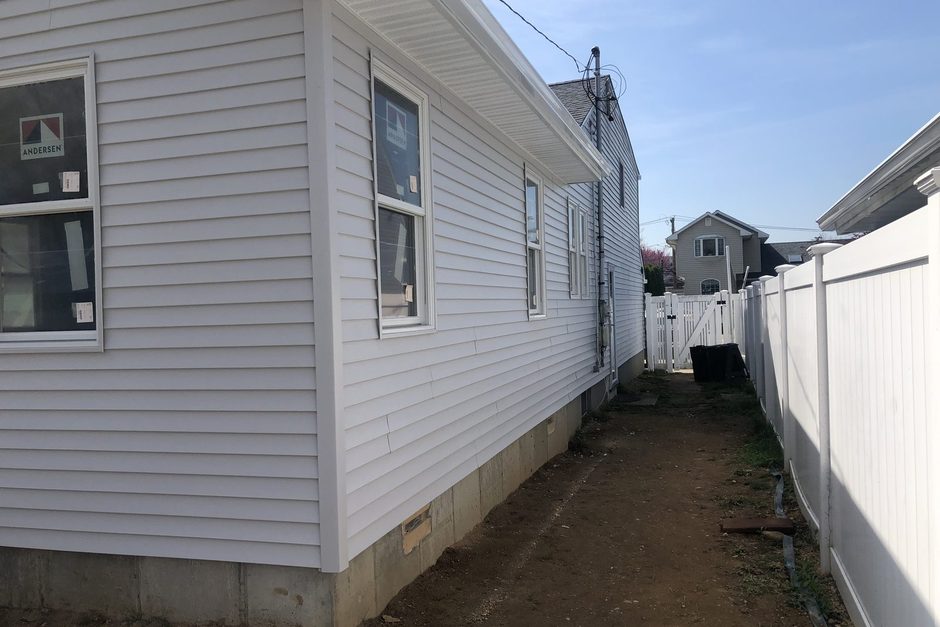
Start outside with a camera, before you move anything.
Photograph everything before you move a single panel out of the yard. Work from the property line in: each side of the house wide, then close on the damage, then the debris where it landed. Whoever you talk to later, insurer or contractor, will want to know what it looked like undisturbed.
Do the whole walk from the ground. Wind loosens things without finishing them, and the trim hanging half on this morning is what comes down on somebody this afternoon.
Look for what changed rather than what looks wrong. A gutter that used to run level and now pools at one end, a window that never leaked and now has a damp sill, a corner post with a gap in it. Those details tell a contractor where to open the wall, and nobody remembers them a week later. Check the basement and attic too, because water that gets in high shows up low.
A nor'easter pushes rain sideways, so the stain is rarely under the leak.
A nor'easter does not drop rain on your house. It pushes it sideways at the wall for hours, out of the east and northeast, hard enough to force water up under siding laps and behind window trim. The stain you find inside almost never sits below the place the water got in.
Lap siding drains, it does not seal. Each course sheds water running down the wall and does that job for decades, but it was never built to stop water arriving horizontally and getting driven up behind the lap. Window flashing has the same limitation.
Behind the siding, water runs down the sheathing until something horizontal catches it, usually a band joist, well away from where it entered. Homeowners point at a bedroom ceiling when the failure was a sealant joint ten feet to the side.
Housing stock decides how bad this gets. A post-war cape or 1950s ranch still carrying its original wall assembly may have no modern housewrap back there, just board sheathing and building paper gone brittle. That is why one house on the block takes on water and the newer one next door stays dry.
What is urgent, and what can wait for a proper repair.
Two questions sort the list. Is it still moving in the wind, and is water still getting in or sitting somewhere it should not be. Anything that answers yes belongs to today. The rest is a repair you can schedule properly, with material that matches and a crew that is not rushing.
Deal with these today:
- A hanging panel, a length of trim or a gutter section swinging off the fascia. It does more damage on the way down than it did coming loose.
- Any opening the rain is still coming through: a broken pane, a failed door seal, a gap where trim tore off a wall the weather is still hitting.
- Standing water indoors, and wet material staying wet. The only item here that runs on a clock.
- Anything resting on the line to your meter, which is a call to the utility.
The rest can wait: dents on a wall that is not leaking, a bent gutter that still drains, cracked sealant, a displaced panel where the wall behind is dry. All of it goes better on a dry day with matched material.
Drying the inside decides whether you have a repair or a much bigger job. If a cavity is wet, open it and get air moving. Closing up a damp wall is how a two-day siding repair becomes framing work in January.
Siding: the panel in the driveway is the smallest part of it.
The panel in the driveway is evidence of what happened, not the extent of it. Vinyl fails at the nail hem, and the gust that pulled one course loose put the same load on the courses above and below. The question is the condition of the wall behind, and whether water is still sitting in it.
Wind gets its grip at edges, not mid-wall: corner posts, J-channel around openings, the starter course, the gable run. Check those even on walls that look untouched.
Two things complicate the repair. Matching is the first: a color fifteen years in the sun is no longer the color on the sample chip, so a patch on an exposed elevation reads as a patch. What is underneath is the second, since plenty of Long Island houses have cedar shakes buried under the vinyl. Wet sheathing has to dry or come out, and covering it is the most common storm repair mistake we see.
Gutters and leaders: the cheap-looking damage that floods a basement.
A leader knocked off its elbow looks like the least of your problems and is often the most expensive one. It takes everything the eave collects and pours it against the foundation, into ground a nor'easter has already saturated. Long Island basements tend to flood the day after a storm rather than during it.
Check that the leader is connected top and bottom and discharging away from the house, that the gutter is not holding standing water, which would mean a hanger let go and the pitch changed, and that the fascia is sound. A gutter that pulled loose was usually hanging on rotted wood already.
Timing matters here more than anywhere else. Long Island's nor'easter season runs from roughly late September through April, so a storm this week is the first of the run, not the last. A gutter reattached badly in October gets tested again in February with ice in it, which is why gutter work starts with the wood it hangs on.
What the town wants before the repair, and what it does not.
Replacing siding, a gutter run or a window in its existing opening is ordinary work. Anything that touches framing is a different matter, and storm damage has a way of turning one into the other once the wall is open. The town decides which one you have, and that answer is a phone call away.
New York builds to the State Uniform Fire Prevention and Building Code, but the state does not enforce it on your house. As the Division of Building Standards and Codes puts it, generally every city, town, village and county administers and enforces the code within its own jurisdiction. In Bay Shore, that is the Town of Islip.
The Islip Building Division reviews permit applications against the state Uniform Code, the Town of Islip Zoning Code and the town's land development regulations, and filing is electronic. Stay inside the same opening and footprint and the conversation is short. If a header is compromised or an opening changes size, expect a permit and a licensed engineer, which is who we bring in when framing is involved.
Do not take "it is storm work, no permit needed" from somebody in your driveway. Theirs is not the answer that counts when the house sells and somebody pulls the file at the town.
The truck that shows up that afternoon.
Crews work the neighborhoods the same afternoon after a bad storm, and the pitch is always urgency plus a discount that expires today. Nothing about storm damage obliges you to sign anything inside 48 hours. Stabilize the house first, then hire the repair the way you would hire any other job.
Two checks take five minutes. Ask for the home improvement contractor license number for the county the work is in and look it up yourself. Ask for a local address, not a cell number and a magnetic door sign. Ours is NY #H0309970000, out of West Babylon since 1989. Longer version in our piece on choosing a contractor.
What drives the cost of putting the envelope back.
Nobody can price storm damage from a photograph, and anyone who tries is guessing. What moves the number is how far the water travelled, whether the sheathing is sound or has to come out, how much of the elevation comes off for the repair to disappear, and whether fascia carpentry is involved.
Condition matters as much as damage. A wall on its third siding installation carries accumulated fastener holes, which changes what can be reused. So does the age of the window beside it: a forty-year-old frame is a different job from an Andersen unit.
Get the scope in writing before any money moves: what comes off, what goes back on, what happens if the sheathing is wet, and who pulls the permit. We will walk the elevations and put a written quote in your hands within a business day or two. Our notes on winter prep and siding work cover what comes next.